This was one of the first recipes I ever learned. I suspect the original recipe appeared on the bottle of Kikkoman soy sauce in 1965. Although I’d had soy sauce in Chinese restaurants, it felt like an exotic new condiment in the kitchen.
I think the original recipe, from the label may have called for little besides soy sauce and brown sugar. Over the years, other ingredients came and went—but the basics were soy sauce, sugar and/or honey, ginger, garlic, sometimes apricot preserves. There was always a lot of sauce to pour over rice.
I prefer to use dark meat—thighs are easiest. Marinate thighs in mixture of soy sauce, lemon juice, crushed garlic, and chopped ginger for a few hours or overnight.
Add honey or brown sugar and a dollop of apricot preserves—arrange chicken pieces in single layer in glass baking dish. Bake at 350 for about 40 minutes.
Put in broiler at end to get skin brown and crispy. There should be lots of sauce. Top with chopped cilantro and/or scallions and serve with rice.
Showing posts with label Poultry. Show all posts
Showing posts with label Poultry. Show all posts

40 - Chicken Marbella

Chicken Marbella---how we loved this recipe when we discovered it decades ago in The Silver Palate Cookbook.
It is indeed humbling to acknowledge what an unwitting follower I was of cookbook trends and/or fads. Or was it that these recipes miraculously plugged exactly into our cooking desires? Trader Joe would eventually tap these same needs. In the days before we were quite so focused on local and organic produce, the Trader understood our longings for relatively healthy, inexpensive, very sweet and especially convenient foods all presented with a little spice and clever zip.
In any case, almost everyone I know (who has ever made any pretense of cooking) still has a worn, tattered copy of the Silver Palate Cookbook published in 1982, recipes full of butter and sugar, bold print and lovely line drawings.
I prepared hundreds of platters of Chicken Marbella over the years. Early on I added apricots making it even sweeter and more colorful. It was great for dinner and for picnics.
The recipe in the Silver Palate was for four small quartered chickens. I used the equivalent of two chickens--about six pounds--either entire chickens or just dark meat (I'm always happier with legs and thighs--and even fans of white meat like dark meat fine in this dish). Although I cut the amount of chicken in half, I happily used the full amount of seasonings.
The first step is to make the marinade—you can do this one or two or even three days in advance if you feel like it.
In a large bowl combine chicken, an entire head of garlic--each clove peeled and crushed, 1/4 cup dried oregano, salt and freshly ground black pepper, 1/2 cup red wine vinegar, 1/2 cup olive oil, 1 cup pitted prunes, 1 cup dried apricots, 1/2 cup pitted Spanish green olives, 1/2 cup capers with a bit of juice and 6 bay leaves. Cover and refrigerate over-night, or longer.
When ready to cook--preheat oven to 350. Arrange chicken in a single layer in a large, shallow baking dish. Cover with the marinade. Add 1 cup brown sugar--trying to keep it atop the chicken pieces--and pour 1 cup white wine over it all.
Bake for 50 minutes to an hour, basting often with the pan juices. It's done when the juices of thighs or drumsticks, when pierced with a fork, run clear.
Transfer chicken pieces, olives, dried fruits and capers with a slotted spoon to serving dish. Add a bit of the juice and sprinkle generously with 1/2 cup parsley or cilantro. Serve most of the juice on the side (you might want rice or noodles, as well as bread to sop up the juices).
42 - Roasted Chicken with Lemons


This recipe has its roots in More Classic Italian Cooking by Marcella Hazan. For years, I made it just as she advised. Now, I’ve abandoned the elegant simplicity and embellish with garlic and vegetables.
Preheat the oven to 350.
Rinse a whole chicken, inside and out in cold water --maybe 3-31/2 pounds (many cookbooks suggest smaller chickens--but perhaps the chickens are getting bigger these days--most seem to be over 3 pounds). Remove all bits of loose fat. Drain for about ten minutes and dry well.
Rub a fair amount of salt and freshly ground pepper into the chicken. On occasion, I've slipped some chopped parsley and garlic under the skin. Certainly not essential--but feels like a fine innovation--and makes for a good visual effect. Here it is with herbs under skin before being put breast down and going into oven.

Rinse two lemons in cold water and soften them by rolling them back and forth in your palms. Poke the lemons in man places with a fork, or a round toothpick--or any other appropriate sized tool.
Place both lemons in the chicken's cavity. I also add some cloves of peeled garlic, and a few springs of parsley--depends on the size of the chicken--if the cavity is bigger--I throw in more herbs. Close the opening with a few toothpicks.
Cut four or five carrots, two onions and three or four potatoes in largish chunks. Place chicken breast side down in a roasting pan, and surround with the vegetables. (This is of course optional--if there is no room in the pan forget it--and if you want your vegetables to be vegetarian--just roast them separately).
Place in upper third of the oven. If you have lots of vegetables, you might want to add a bit of olive oil. If you don't put in the vegetables, you don't need any fat. The bird will baste itself--one of the miracles of this dish in its pure form. After about twenty minutes turn the chicken so the breast side is up (maybe even longer if it's a big bird). Cook for another 20-25 minutes. Turn the heat up to 400 and cook for another 15-25 minutes (again--cook it longer if it's bigger). Here it is nicely roasted:

Check for doneness in the usual manner--nicely browned, legs moving freely, juices running clear. And that is it.
43 - Roast Turkey
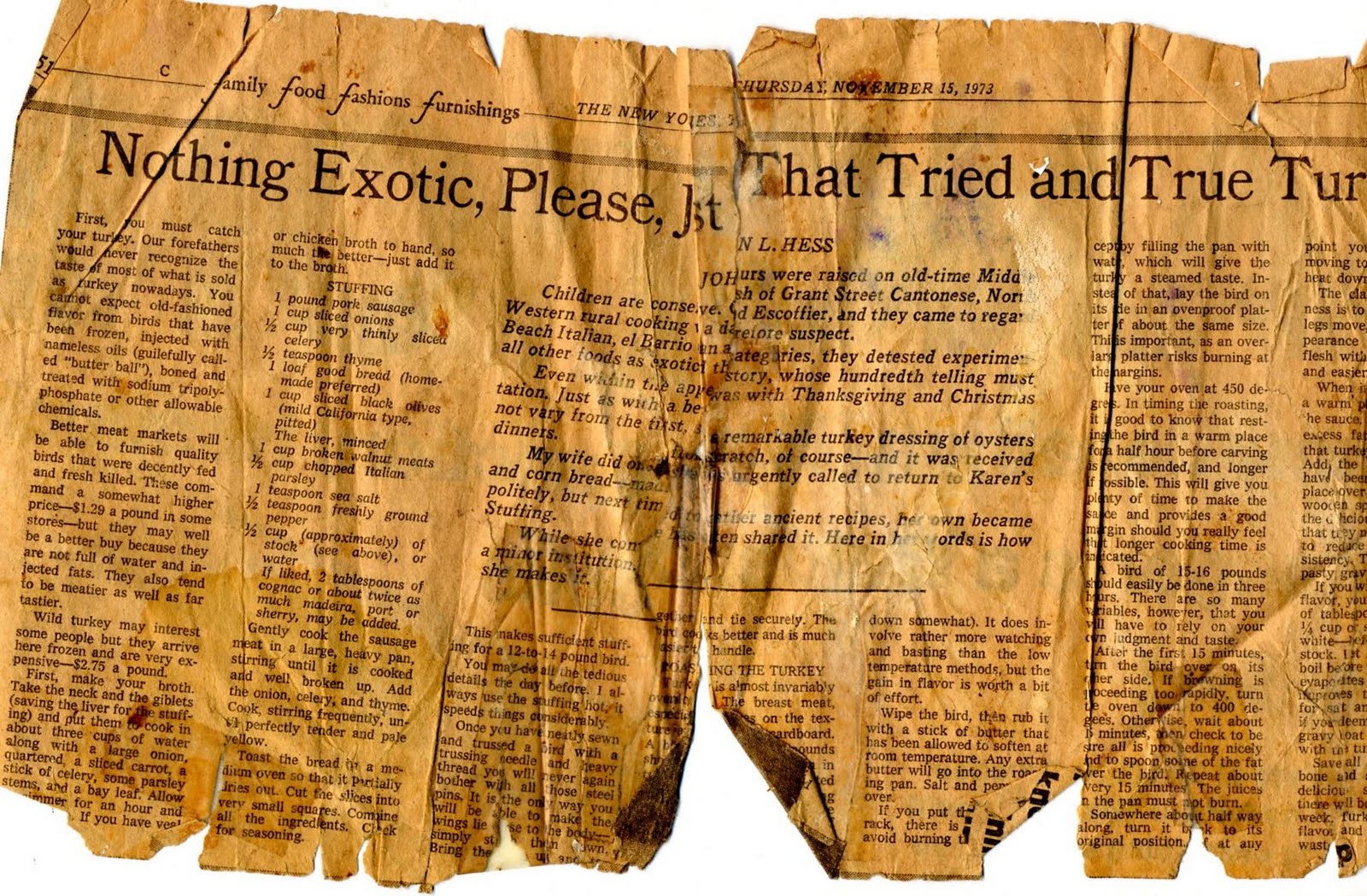
For decades I have been a devotee of the high speed/high temperature turkey-roasting method that I clipped from the New York Times in 1973. In that now crumbling yellow newsprint, John and Karen Hess convinced me that for the small price of basting every fifteen minutes (as well as two very dramatic turkey flips) we could have a splendid turkey, cooked to a golden brown turn in less than three hours. I suspect I made that first high-speed recipe for my parents who drove from New Jersey to our apartment in Somerville, but alas, although that should have been a momentous occasion—relatively young bride cooking in her own home for her parents--,I cannot conjure that meal. Luckily, there are scores of other turkeys in the memory bank to fill the gap. I used to search for the biggest turkey in the universe that we could squeeze into our oven—maybe 26 or 27 pounds--but now, I tend to go for something in the range of 10-15 pounds, still more than enough.
The Thanksgiving turkeys that loom largest in memory or those we ate at our home on Breeze Avenue in Venice. Sometimes it was to serve multitudes--but even so--it was probably three times what we needed.
Here’s the recipe—with various additions and subtractions made over the years. In addition to my original golden brown 1973 clipping, I have a page torn from the New York Times Magazine at turn of this century by Jonathan Reynolds, which I don’t believe I’ve ever really used, but looking at it now, I see I clipped it because it was an endorsement (with brining) of my age-old favorite.
We began brining in the late 90’s. Although it doesn’t involve actual cooking, I suspect it does satisfy part of my long-ago urge to have the turkey underway the night before we actually eat it. This soaking is to help the breast stay moist while the dark meat cooks thoroughly. Although I’d always felt that our high temperature method solved that problem, I have not been able to resist this extra step. As our turkeys, i.e. the turkeys we buy, have grown smaller over the years, we no longer need a swimming pool to brine our turkey and the task is not quite so daunting.
The Brining:
Mix a cup or two of kosher salt in two or three gallons of water until dissolved. I’ve found it easier to do this in a big plastic bag, which I put in a large bowl or bucket. The goal is to squeeze it into the refrigerator, but if we’re in a cold enough clime, we can manage keeping it out, as well.
In the morning, rinse the turkey (otherwise it can end up on the salty side—dry off—and put in the fridge until an hour or so before cooking.
The Broth:
Put the turkey neck and giblets (which you removed before brining) into a sauce pan. At this point, for a morning snack, you can sauté the liver in butter and eat it immediately!
Add an onion cut into quarters, a roughly chopped carrot or two, a stalk of celery, a big handful of parsley and a bay leaf. Add three of four cups of water—bring to a boil, and then turn down to a very slow simmer, while you proceed.
The Stuffing:
I’m not quite sure why, but we departed years ago from the Hess sausage recipe.
The night before cooking the turkey, make corn bread. Combined with the brining, this satisfies my need to start the turkey way in advance. Follow recipes for any simple corn bread. Cut it up to facilitate drying (i.e. make it stale).
The turkey should be out of the refrigerator about an hour before cooking—so you might want to take it out before you leap into the stuffing:
Cut the corn bread into one inch cubes (you can be very casual here—if you prefer to crumble—you can go that route.) Put bread in large bowl.
Melt ½ stick of butter
Sauté 1 cup sliced onions. After the onions have cooked a bit add ½ cup finely sliced celery. When vegetables are soft, add to bread.
Then add:
1 cup chopped dried fruit—apples, apricots, rains, cranberries, whatever…
½ cup chopped walnuts
½ cup chopped parsley
Salt and pepper to taste.
If I’m taking the vegetarian path (for extra stuffing not cooked in turkey) and the mixture isn’t moist enough—I’ll add more butter or water to part of the stuffing.
The stuffing that goes in the turkey will absorb turkey juices—but if the broth has been cooking a while—I might add some of that as well.
At some point, turn on the oven to pre-heat at 450 degrees.
Into the Oven:
When the turkey is happily stuffed, rub it all over with a softened stick of butter (any extra butter can go in the pan). Add salt and pepper.
Although I have made this bird scores of times, I never quite believe how quickly it cooks—so I will repeat the instructions here—a 12-14 pound bird, should be done in about two and a half hours, a 15-16 pounder, in three. When we made the gigantic birds—25 pounders—they might take 3 ½ hours—but I’d advise staying away from those big ones.
Put the turkey, on its side, in a roasting pan just large enough to hold it and slide into oven.
After about fifteen minutes turn the bird to its other side—you should try not to tear the skin—many recipes discuss a V shaped rack—but since I’ve never known what that is—and since the Hesses cautioned against it—I have always just gone with the straight pan. On to the basting!
I’ve always used the classic turkey baster, and faithfully baste every fifteen minutes. When you think you're about half-way through--after an hour or so--depending on the size of your bird, you should flip it one more time. If you get nervous (which I often do) and feel that the cooking is going too quickly, i.e. if it looks like the juices are burning in the pan, you can turn the heat down--to 400, 375, whatever. You have to be brave. You could also do a little research--needless to say, the degree of heat, length of cooking, etc. are all subjects of much internet debate. You basically have to trust yourself.
When the turkey is golden brown—or deeper brown—and you do whatever tricks you need to ensure it’s doneness—perhaps a thermometer deep in the thigh, juice running clear when pierced with a knife—various incantations, remove from oven—take it out of pan. While the turkey is resting—prior to slicing—put the pan on top of the stove—skim off some of the fat—then you can add some add the stock that has been simmering for hours. Bring to a boil, scraping off the bits of meat and skin from the bottom—let it reduce, add salt and pepper —and voila—a perfect light gravy.
Subscribe to:
Posts (Atom)